
After survival, who am I? Listening to your body when identity shifts.
After survival, who am I?
I thought the hard part of life was surviving.
Illness. Burnout. Responsibility. Expectations.
No one speaks about what comes after.
The moment when everything looks fine.
Yet the person who lived that life is no longer there.


When identity no longer fits
From the outside, nothing looks dramatic.
You function. You show up. You are still “the strong one.”
But inside, your system has stepped aside.
Whether you are 35 and exhausted by corporate life, or 55 redefining yourself after breast cancer, the signs are similar:
The job that once defined you feels distant.
Old goals don’t excite you.
Your energy drops where you used to push through.
You feel neither depressed nor enthusiastic - just… unaligned.
This is not failure.
This is not laziness.
Your nervous system refuses to live in a house that no longer fits.
The identity that helped you survive
may not be the one that helps you live.


My body spoke before I did
A normal meeting. Laptop open.
I was speaking, nodding, doing everything right.
Then I noticed my breath.
Shallow. High in my chest.
People discussed plans and targets.
And I had one clear thought:
My body is not here.
My voice was there. My competence was there.
No breakdown. No drama.
Just a simple signal: But my system had stepped out.
The body does not lie
We treat racing heart, exhaustion, sudden tears as problems.
But what if your body is the only part of you honest enough to tell the truth?
That tightness in your throat when you say “yes” to something you don’t want?
Information.
The deep breath you take when you are finally alone?
Direction.
After illness, burnout, or long-term stress, the body becomes less tolerant of performance.
It knows the cost of pretending.
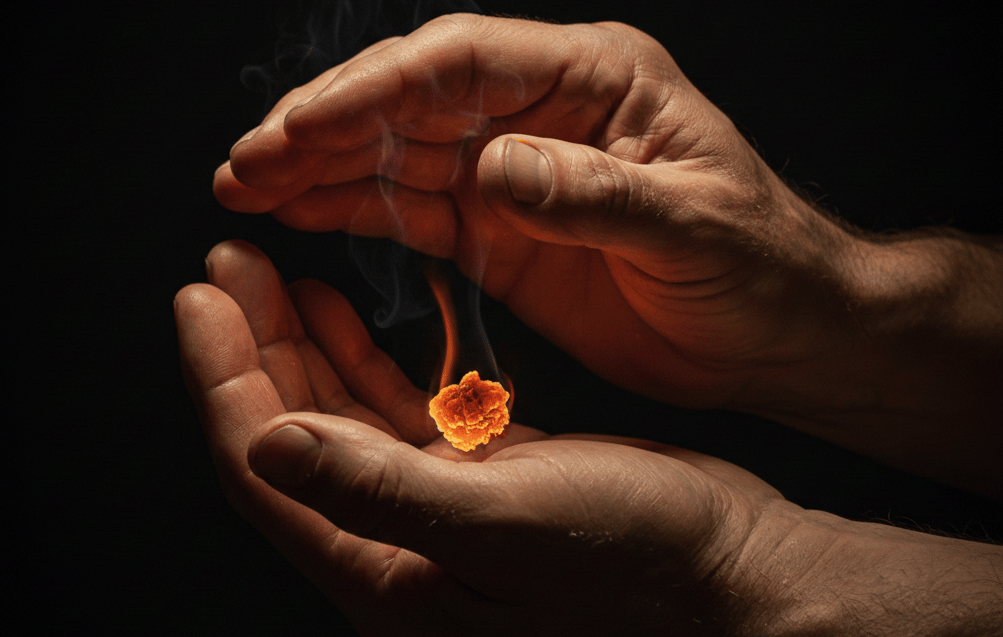
Identity doesn’t break. It outgrows.
We talk about identity crisis as if something is wrong.
But this phase is often transition.
The question shifts from:
“How much more can I endure?”
to
“What is true for me now?”
The answers are rarely dramatic:
Less noise.
Fewer roles.
More space.
More alignment between inner state and outer life.
Who am I if I stop performing?
Who am I if I am not “the strong one”?
Who am I when the crisis is over?
Learning to listen to your body
I practice this in small ways.
When tasting wine, I ask not what wine it is, but who it is.
A wise old man? A good friend? A demanding boss? Or a young charming girl?
It sounds like a game. But it trains something real:
feeling before explaining.


Between identities
There is a phase where the old self has faded and the new one has not yet formed.
You might be here.
I call it a Shabbat.
A pause from producing and proving.
Long enough to hear who you are when you are not fighting.
It is often where the most honest version of you is being formed.
I don’t have the full map yet.
I don’t have a new identity either.
But I have something better: the feeling of my own breath.
When my shoulders drop and the tension leaves,
I am closer to my life than when everything looks impressive.
For now, that is enough.
Let that be enough for you, too.


Worlds Within
Beautiful. Unfinished. You.
Contact me:
© 2024 Worlds Within. All rights reserved.
life@worldswithin.life