
Stoic wisdom. The future is new. The Stoics are timeless.
The future is new. The Stoics are timeless.
I was sitting at my desk, surrounded by tools designed to make me feel in control.
AI summaries, color-coded planning apps, and endless digital notes promised me total clarity. On paper, everything was possible.
And yet, I felt strangely hollow.
It wasn't anxiety or sadness. It was the feeling of being "unanchored" as if I were floating in a sea of infinite options with no compass to guide me.
How can we have so much information, yet so little direction?


What I see in others and recognize in myself
In my work, I meet people who are intelligent, reflective, and outwardly functional. They have tried every productivity method and read every self-help book. And still, many of them say the same thing:
“I don’t know what I want anymore.”
“I feel busy, but I don’t feel moved.”
“I’m doing well, but I don’t feel well.”
It’s not a crisis - it’s overload. A decision fatigue.
Too many imagined futures, and too little inner gravity.
And if I’m honest, this is not only something I observe. It’s something I have had to navigate myself, especially in periods of transition, illness, recovery, and letting go of roles that once defined me.
That is why I returned to Stoicism. Not as a dry philosophy, but as a practical orientation.


Ancient wisdom for modern stress
The future is new, but we are not. While technology moves faster, the inner human experience - the tension between control and helplessness - has not changed.
The Stoics didn’t have AI or planning apps, but they had the same racing hearts and crowded minds. They weren’t trying to solve the future; they were trying to help us stay undivided within it.
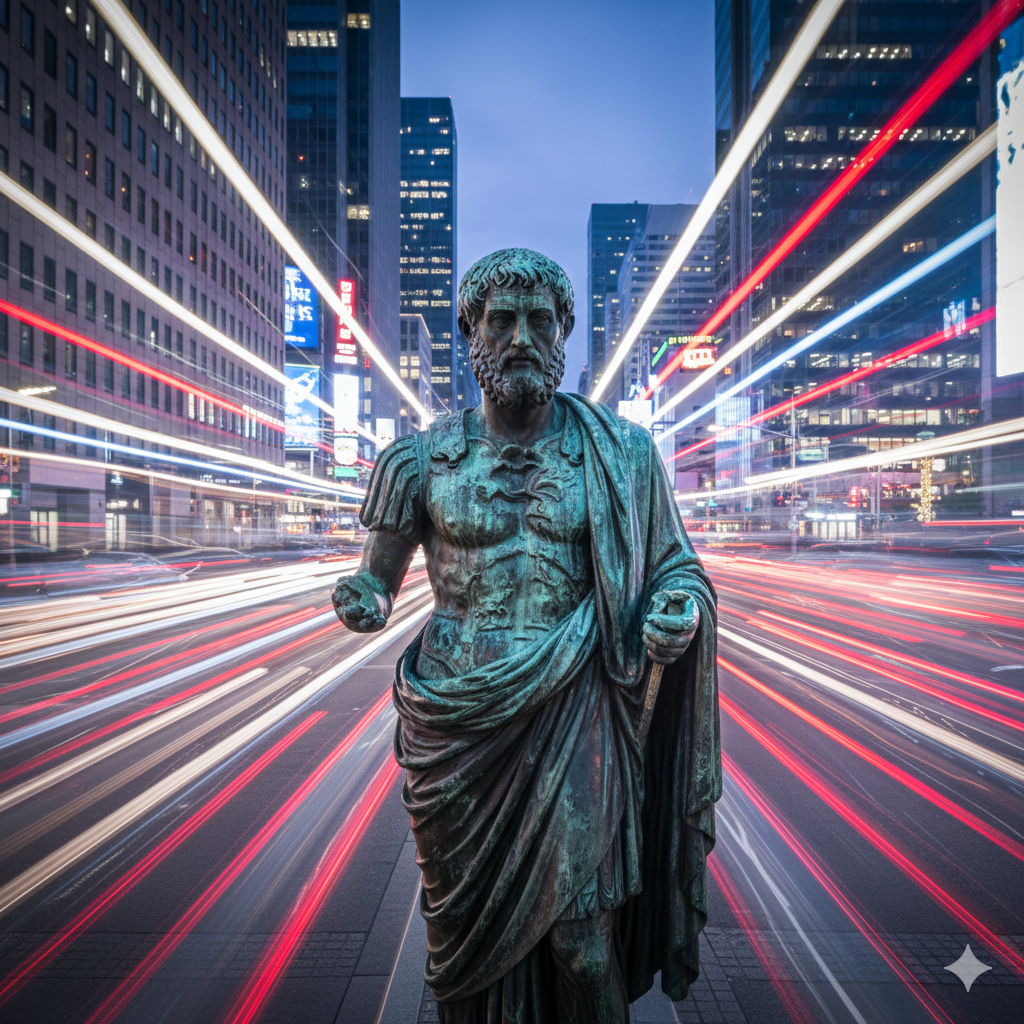
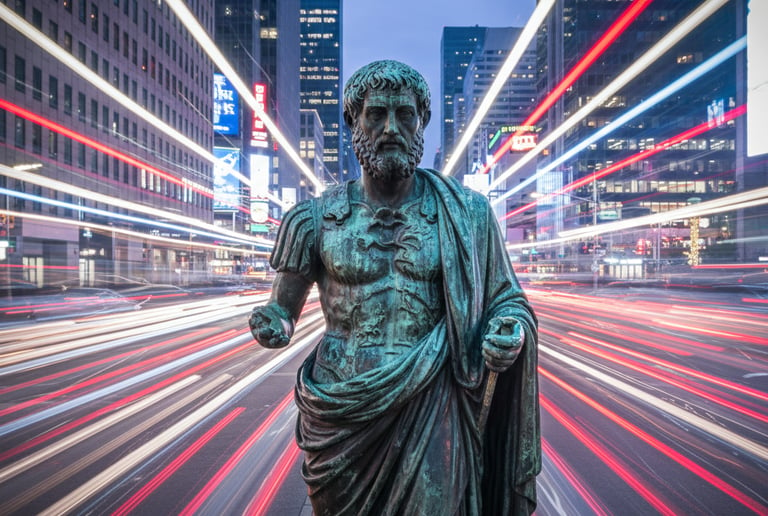
Epictetus and the Circle of control
Most of our energy is spent trying to manage what was never ours to manage.
Some things are yours.
Some things are not.
Your thoughts. Your words. Your actions - yours.
Other people. Outcomes. Timing - not yours.
Most modern stress comes from crossing that line, daily.
When you step back onto your side of the line, something happens.
The nervous system exhales.


Marcus Aurelius on staying human
Marcus ruled an empire in crisis.
His journals remind us:
Do not let chaos make you cruel.
Do not let responsibility take your compassion.
In a world that rewards speed and performance, staying true to your values is no longer automatic. It is a choice.


Seneca on anxious mind
Seneca observed how we "suffer in advance."
We spend our lives twice - once in fear, once in reality.
His message is vital for the anxious mind:
Protect your time and your self-respect.
Do not let imagined tomorrows steal today.


Moving from information to integration
Knowing these Stoic principles is one thing.
Living them when your phone is buzzing and your heart is tight is another.
That is the gap where we usually lose ourselves.
At the end of the day, ask yourself:
What was mine to handle today?
Where did I try to control the uncontrollable?
What matters enough to carry forward?
These questions are a beginning, but finding true ground in a chaotic world is rarely a solo mission. While the reflection starts in private, the integration happens in dialogue.
This is where my work lives. I help high-performers move from "doing well" to "being well." If you are ready to stop drifting and start anchoring, let’s start a conversation.


This article is part of my series on Aging with wisdom.
Read also:
Cicero would’ve been a great dinner guest
Confucius didn’t rush. Maybe I shouldn’t either
Nietzsche. Too old for pretending, too young to stop
Montaigne. I’m 59. Still curious. Still learning.
Worlds Within
Beautiful. Unfinished. You.
Contact me:
© 2024 Worlds Within. All rights reserved.
life@worldswithin.life